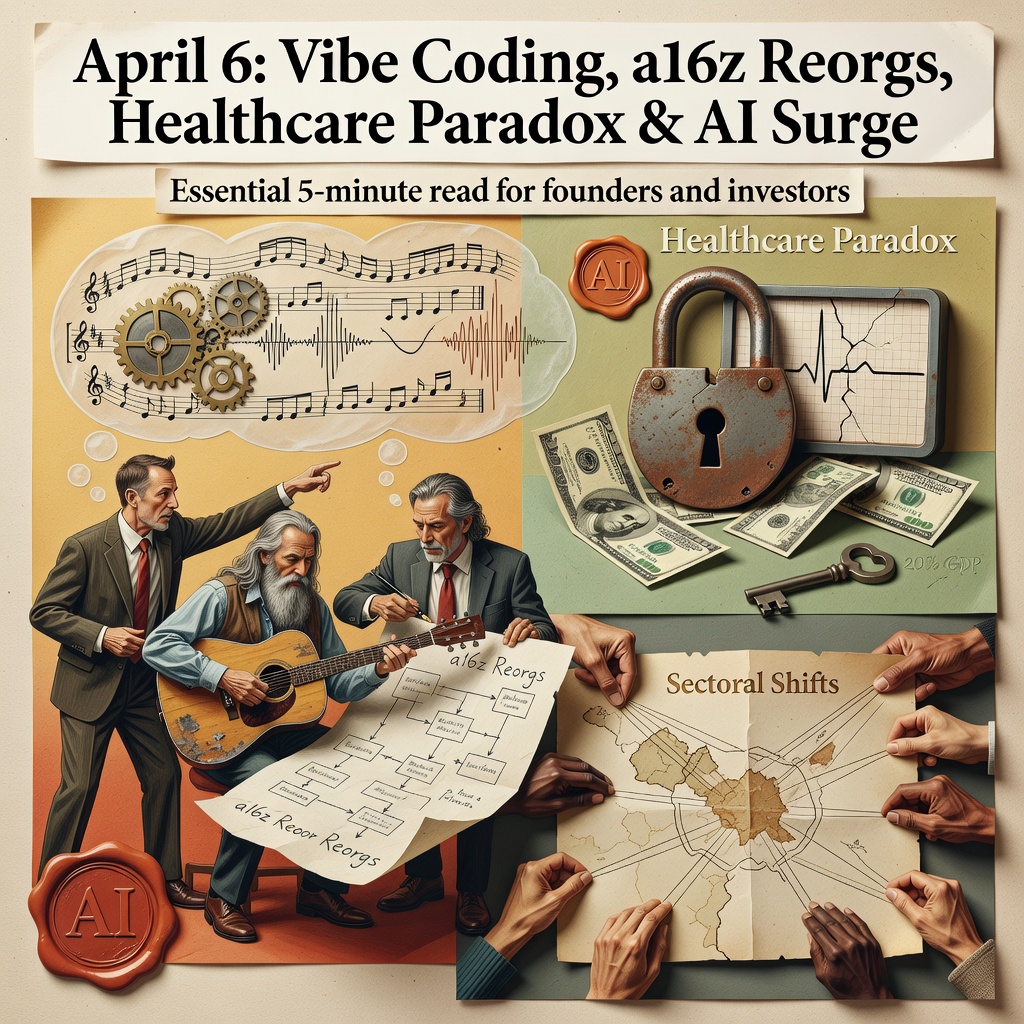
April 6: Vibe Coding, a16z Reorgs, Healthcare Paradox & AI Surge
Marc Andreessen, Rick Rubin, Ben Horowitz and a16z partners dissect AI creativity via 'vibe coding', firm reinvention through reorgs and policy, why US healthcare resists tech despite 20% GDP spend, and open source's role in sectoral transformation. Essential 5-minute read for founders and investors.
Vibe Coding as the Punk Rock of Software
Rick Rubin turns a meme into a Tao Te Ching for the AI era, arguing intuition and authenticity beat technical mastery.
Rick Rubin dropped a modern manifesto by adapting the 3000-year-old Tao Te Ching into 'The Way of Code'. 'Tools will come and tools will go. Only the vibe coder remains' [1]. He treats AI exactly like past technologies in music: a tool for remix, where the artist's point of view and authenticity matter more than technical skill. Punk rock let anyone with three chords and an idea start a band. Vibe coding does the same for software [2]. Marc Andreessen endorses this as essential for the AI age, where LLMs handle syntax and founders succeed through taste and direction. Ben Horowitz connects it to company building. The panel of Anjney Midha and Erik Torenberg adds that this shifts software from atomic code units to intuitive flow. These positions add up to an emerging consensus. AI does not replace human creativity. It amplifies those who operate on vibe first. The evidence from Rubin's rapid book and the podcast reaction suggests this resonates because it matches what early AI-native builders already feel. No genuine split exists here. Instead it forms a practical philosophy for the briefing's other threads: intuition must guide how firms reorganize, how entrepreneurs attack healthcare, and how we bet on open source models. [3][4][5].
“Tools will come and tools will go. Only the vibe coder remains.”— Rick Rubin [1]
Sources (5)
- Rick Rubin: Vibe Coding is the Punk Rock of Software — Rick Rubin“Tools will come and tools will go. Only the vibe coder remains.”
- Rick Rubin: Vibe Coding is the Punk Rock of Software — Marc Andreessen“AI as an artistic tool akin to others in remix culture, emphasizing authenticity for creators and founders.”
- Rick Rubin: Vibe Coding is the Punk Rock of Software — Ben Horowitz“Leaders discuss strategies for building resilient companies amid technological shifts.”
- Rick Rubin: Vibe Coding is the Punk Rock of Software — Anjney Midha“One of the emerging patterns in the vibe coding space.”
- Rick Rubin: Vibe Coding is the Punk Rock of Software — Erik Torenberg“Joined by a16z General Partners Anjney Midha and Erik Torenberg.”
a16z's Evolution to Multi-Practice Platform
Reorgs beat returns. Specialization and bipartisan policy advocacy define the new VC playbook in the AI era.
Marc Andreessen and Ben Horowitz describe a16z as an adaptive organism that has reorganized repeatedly since its 2008 crisis launch. Reorgs, not just returns, determine who wins [1]. The firm moved from generalist startup investors to vertical specialists with dedicated practices in bio, crypto, consumer, and more. Policy advocacy in Washington on AI and crypto became table stakes, executed with a bipartisan lens to support Little Tech against incumbent regulation [2]. Marc personally screens hires via social media to protect culture. Ben stresses building an enduring franchise amid rapid narrative cycles. Erik Torenberg frames this as the evolution from pure VC to multi-practice platform. The positions add up to a clear view. In an era of accelerating technology, venture firms must treat themselves as products that require constant reinvention. Scale becomes an advantage when paired with specialization and policy muscle. The evidence from a16z's own history supports this. No major disagreement appears. Instead these entries form a playbook for other firms and the founders they back. This institutional agility connects to vibe coding because both prioritize intuition and rapid adaptation over rigid legacy approaches. It also explains why healthcare transformation remains so difficult. [4][5][6].
“a16z has transformed from a startup firm into a multi-practice platform, emphasizing reorgs over mere returns as key to competitive success in venture capital.”— Marc Andreessen [1]
Sources (6)
- The Evolution of the Firm with Ben and Marc — Marc Andreessen“a16z has transformed from a startup firm into a multi-practice platform, emphasizing reorgs over mere returns as key to competitive success in venture capital.”
- The Evolution of the Firm with Ben and Marc — Ben Horowitz“Leaders Marc Andreessen and Ben Horowitz discuss rapid meme-speed media narratives, enduring franchise building, and a bipartisan approach to AI and crypto policy advocacy in Washington.”
- The Evolution of the Firm with Ben and Marc — Erik Torenberg“Marc personally vets hires by screening social media profiles to maintain cultural fit.”
- What We Got Right and Wrong About the Future of Tech — Marc Andreessen“Andreessen Horowitz raised its first fund amid the 2008 financial crisis and adapted by developing a multistage, multi-sector strategy.”
- What We Got Right and Wrong About the Future of Tech — Marc Andreessen“Now prioritizes policy impacts on startups alongside the rise of Little Tech.”
- What We Got Right and Wrong About the Future of Tech — Ben Horowitz“Discussions also cover founder evolution, global talent dynamics, and tech's societal role.”
The US Healthcare Paradox
20% of GDP spent for subpar outcomes. Regulatory bottlenecks and misaligned incentives block the tech transformation that seems obvious.
Marc Andreessen, Vijay Pande and Julie Yoo dissect why America spends twice as much as peer nations on healthcare yet delivers worse results. The numbers have not budged for decades. 20% of GDP. Poor life expectancy and outcomes relative to cost [1]. The diagnosis is clear: regulatory bottlenecks, misaligned incentives between payers, providers and patients, and cultural inertia. Marc questions whether technology is the remedy or a red herring but leans toward remedy if entrepreneurs can navigate the maze. Vijay Pande frames AI as super staffing that augments doctors and nurses rather than replacing them, sidestepping some Moravec's paradox issues where easy human tasks remain hard for machines. Julie Yoo emphasizes targeted disruption in specific areas like diagnostics, administrative burden, or chronic care rather than frontal assault on the entire system. The positions add up to tempered optimism. AI and tech can drive transformation but only if policy and incentives change. The evidence from decades of stalled progress supports the caution. This thread connects to vibe coding because healthcare builders will also need intuitive, adaptive approaches rather than purely technical solutions. It also links to a16z's policy focus. Without bipartisan or targeted regulatory reform, the 20% GDP burden will persist even as AI capabilities explode elsewhere. [4][5].
“US healthcare consumes nearly 20% of GDP but underperforms other developed nations in outcomes. Regulatory bottlenecks and misaligned incentives create inertia stalling industry transformation.”— Marc Andreessen [1]
Sources (5)
- The Paradox of U.S. Healthcare with Marc Andreessen — Marc Andreessen“US healthcare consumes nearly 20% of GDP but underperforms other developed nations in outcomes. Regulatory bottlenecks and misaligned incentives create inertia stalling industry transformation.”
- The Paradox of U.S. Healthcare with Marc Andreessen — Vijay Pande“Join a16z general partners Marc Andreessen, Julie Yoo, and Vijay Pande for an incisive exploration of what’s driving—and stalling—transformation in healthcare.”
- The Paradox of U.S. Healthcare with Marc Andreessen — Julie Yoo“Is technology the remedy or a red herring?”
- The Paradox of U.S. Healthcare with Marc Andreessen — Marc Andreessen“The podcast analyzes these issues and provides entrepreneurial insights, questioning if technology can remedy the paradox.”
- Marc Andreessen on Deep vs Broad Founders — Marc Andreessen“Tech's pervasive impact across education, defense, healthcare, and housing sectors.”
AI Surge, Open Source Future, and Founder Bets
AI transforms education, defense, housing and healthcare. Open source compresses margins while deep technical founders compete with broad visionaries.
Marc Andreessen describes AI as the largest technology shift he has seen. It will permeate education by personalizing learning, defense through autonomous systems, housing via design and construction tools, and healthcare despite its paradoxes [1]. Open source models will proliferate and compress economic margins for closed providers even if they do not fully win. The real explosion in productivity still lies ahead and can offset demographic decline. At the LP conference Marc contrasts deep technical founders who understand model mechanics with broad visionaries who see applications across sectors. He leans toward both matter but bets broad application builders win bigger in the surge phase. Ben Horowitz ties this to VC evolution and the need for firms to adapt their own models. The pattern across entries is consistent. AI progress is faster than institutions can absorb. Open source accelerates adoption and forces competition. Policy becomes a competitive advantage for the US versus China. The evidence from current model releases and sectoral pilots supports the surge thesis. Genuine split exists on pace. Some worry about overhype. Marc's position is clear: the boom has not started. This thread ties the briefing together. Vibe coding gives individuals the tool to participate. a16z's reorg gives the firm the platform to back winners. Healthcare shows where the hardest bottlenecks lie. Founders and investors should bet on those combining technical depth, broad vision, and institutional agility. [4][5][6][7].
“Additional topics include venture capital's transformation, a16z's rebranding, and strategies for building resilient companies amid technological shifts.”— Ben Horowitz [2]
Sources (7)
- Marc Andreessen on Deep vs Broad Founders, AI in America — Marc Andreessen“Marc Andreessen discusses AI's rapid rise and the prospects for open source models in a live conversation at a16z's 2025 LP Conference. The talk covers tech's pervasive impact across education, defense, healthcare, and housing sectors.”
- Marc Andreessen on Deep vs Broad Founders, AI in America — Ben Horowitz“Additional topics include venture capital's transformation, a16z's rebranding, and strategies for building resilient companies amid technological shifts.”
- Rick Rubin: Vibe Coding is the Punk Rock of Software — Anjney Midha“Joined by a16z General Partners Anjney Midha and Erik Torenberg.”
- The Evolution of the Firm with Ben and Marc — Marc Andreessen“a16z has transformed from a startup firm into a multi-practice platform.”
- Marc Andreessen on Deep vs Broad Founders, AI in America — Marc Andreessen“Discusses tech's pervasive impact across education, defense, healthcare, and housing sectors.”
- Marc Andreessen on Deep vs Broad Founders, AI in America — Marc Andreessen“The prospects for open source models.”
- Marc Andreessen on Deep vs Broad Founders, AI in America — Marc Andreessen“Additional topics include venture capital's transformation.”
The open question: As vibe coding democratizes creation and AI surges across regulated sectors, which legacy systems will break first, and who is positioned to rebuild them?
