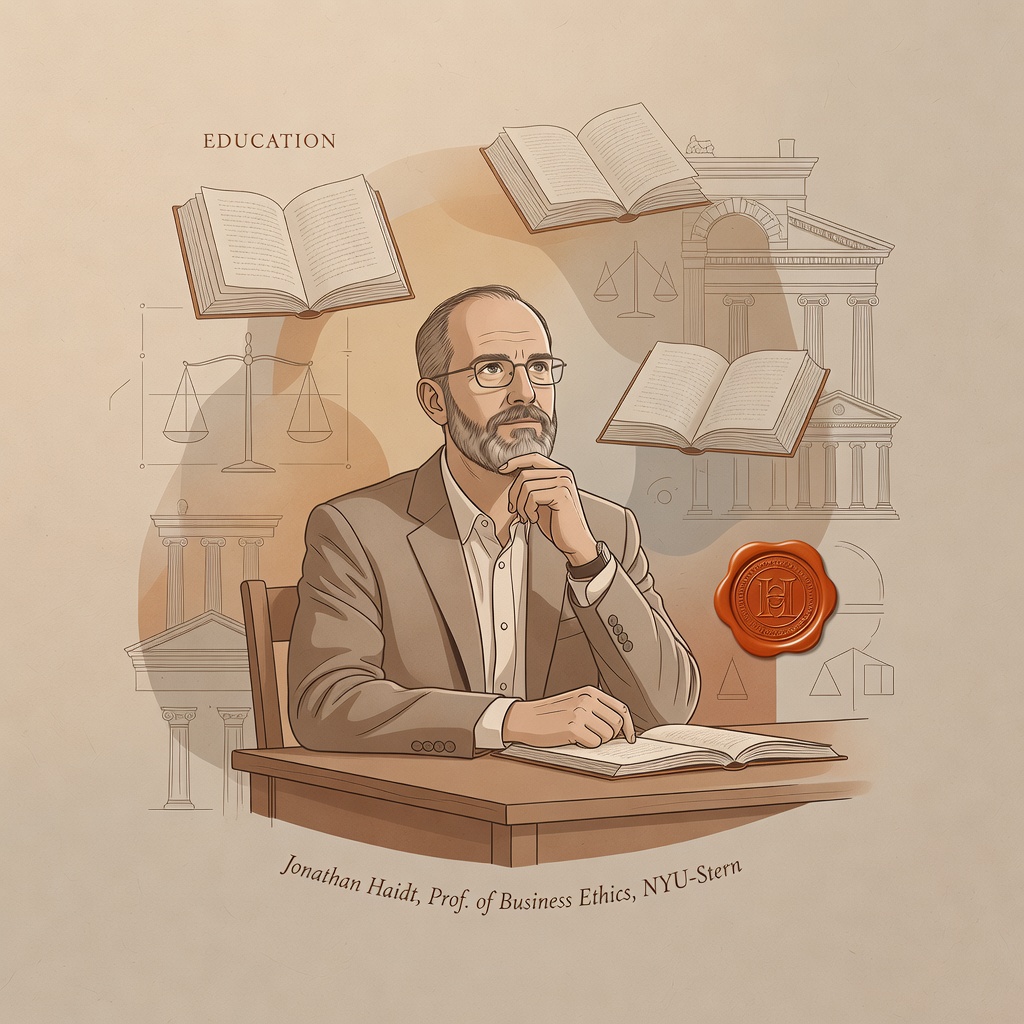
About Jonathan Haidt
Prof. of Business Ethics at NYU-Stern School of Business
Jonathan Haidt is a Professor of Business Ethics at NYU Stern School of Business and a prominent social psychologist specializing in moral psychology. He is best known for his 2024 book 'The Anxious Generation,' which argues that smartphones and social media have triggered a mental health crisis among Gen Z by replacing play-based childhoods with screen-based ones. Haidt advocates for collective norms like no smartphones before age 14 and no social media before 16 to protect youth.
Biography and Background
Jonathan Haidt is a Professor of Business Ethics at NYU Stern School of Business.[19] A social psychologist, he explores moral psychology, hyper-partisan politics, and the societal impacts of technology.[2][19]
The Smartphone Generation Crisis
Haidt attributes the surge in teen mental illness across countries to the shift from 'play-based childhood' to 'phone-based' ones around 2010-2015.[3][4][6] Social media subverts attention and harms girls more through social comparison and relational aggression.[4][8] New evidence reinforces these harms, failing social media's safety test.[6][24]
Solutions and Norms for Parents, Schools, and Policy
Haidt proposes four norms: no smartphones before 14, no social media until 16, phone-free schools, and more independence.[7][12][17] Parents should act collectively, remove 'slot machine apps,' and foster real-world play.[12][34] He shares advice for his own teens and calls for tech regulation.[5][7][26]
Moral Psychology and Broader Societal Impacts
In keynotes, Haidt examines moral foundations fueling U.S. political polarization.[2] He links social media to declining attention, civility, and humanity's trajectory.[8][29][30]
The Anxious Generation Movement
Haidt's book sparked a global movement (TAG) for norms to rewire childhood.[17] He engages in lectures, podcasts, and debates on tech addiction, digital literacy, and policy.[10][23][25][27]
Criticisms and Counterpoints
Some challenge Haidt's views, arguing screens aren't destroying minds or questioning expertise limits.[33][35] He responds with data on the 'uncontrolled experiment' of social media rollout.[24]
Smartphones and Social Media's Harm to Youth Mental Health
Haidt links the post-2010 rise in teen anxiety, depression, and self-harm to smartphone ubiquity and social platforms replacing play.
Collective Action and Norm Changes
Individual fixes fail; Haidt pushes societal norms like delaying smartphones to 14 and social media to 16, plus phone-free schools.
Moral Psychology and Polarization
Explores moral foundations driving political division and how tech exacerbates societal fractures.
Play-Based vs. Phone-Based Childhood
Critiques loss of free play, independence, and real-world risks, replaced by virtual worlds.
Every entry that fed the multi-agent compile above. Inline citation markers in the wiki text (like [1], [2]) are not yet individually linked to specific sources — this is the full set of sources the compile considered.
- Jonathan Haidt, social psychol… – The Interview – Apple Podcastsarticle · 2026-04-14
- Jonathan Haidt Keynote Speaker Bioarticle · 2026-04-14
- Jonathan Haidt on The Anxious Generation: Childhood in ... - YouTubearticle · 2026-04-14
- Jonathan Haidt Brings New Evidence to the Battle Against Social ...article · 2026-04-14
- 'No smartphones before 14; no social media until 16': The Anxious ...article · 2026-04-14
- Can We Save Kids from Social Media? | The New Yorkerarticle · 2026-04-14
- Jonathan Haidt on How to Save Kids from Social Media - YouTubearticle · 2026-04-14
- Thriving Kids: Bonus Episode: Kids, Tech, and Mental Health with Dr. Jonathan Haidtpodcast_episode · 2026-04-14
- The Anxious Generation | Jonathan Haidtarticle · 2026-04-14
- What Parents Can Do Now - After Babel | Jon Haidt | Substackarticle · 2026-04-14
- Essays | Jonathan Haidtarticle · 2026-04-14
- About - After Babelarticle · 2026-04-14
- Social Media | Jonathan Haidtarticle · 2026-04-14
- The Anxious Generation — from a book to a movementarticle · 2026-04-14
- Life After Babel |article · 2026-04-14
- Jonathan Haidt: Social psychologist - Author - Professorarticle · 2026-04-14
- After Babel | Jon Haidt | Substackarticle · 2026-04-14
- Watch Jonathan Haidt on How to Save Kids from Social Media | The New Yorker Radio Hour - The New Yorkernews_article · 2026-04-14
- Four Questions for Jonathan Haidt and Catherine Price - Publishers Weeklynews_article · 2026-04-14
- Social psychologist Jonathan Haidt on the harms of social media and smartphones in the 2026 Compton Lecture - The Technews_article · 2026-04-14
- Research Highlight | Jonathan Haidt | The Uncontrolled Experiment: Why Social Media Failed the Safety Test - NYU Sternnews_article · 2026-04-14
- “It’s a Trap”: The Anxious Generation Author Jonathan Haidt Warns YU Audience About Social Media’s Grip on a Generation - Yeshiva Universitynews_article · 2026-04-14
- How "Anxious Generation" author Jonathan Haidt took on Big Tech - NPRnews_article · 2026-04-14
- Left to Their Own Devices Live: A Conversation with Jonathan Haidt - EPIC – Electronic Privacy Information Centernews_article · 2026-04-14
- How Do We Save Kids from Social Media? - The New Yorkernews_article · 2026-04-14
- Personal tech, social media, and the “decline of humanity” - MIT Newsnews_article · 2026-04-14
- ‘Anxious Generation’ author lays out perils of social media – and offers a way to a more civil future - YaleNewsnews_article · 2026-04-14
- Jonathan Haidt: Why the World Is Drawing a Line on Social Media for Kids - The Free Pressnews_article · 2026-04-14
- Jonathan Haidt Brings New Evidence to the Battle Against Social Media - The New York Timesnews_article · 2026-04-14
- Jonathan Haidt and the Limits of Expertise - Public Discoursenews_article · 2026-04-14
- Get the 'slot machine apps off your phone,' NYU professor tells Gen Z—his best advice for limiting phone use - CNBCnews_article · 2026-04-14
- Opinion | Screens aren’t destroying young minds. I should know. - The Washington Postnews_article · 2026-04-14